Time-series based grid analysis and planning with
Adaptricity.Sim

.dynamisch .datengetrieben .smart

Our super-efficient time series simulation engine offers a variety of algorithms. Simulate dynamic systems to enable flexible grid planning.

The integration of different data sources provides answers to complex questions, and means you will always be working with the most up-to-date data.

Run parallel simulations, and benefit from the automatic control of simulations via our web interface. Keep the overview with straightforward evaluations tailored to your grid analytics needs.

In the future, grid planning and operation will demand an increasingly flexible planning and simulation environment that allows for time-series-based simulations of active distribution grids. Our cloud-based tool, Adaptricity.Sim, with its unique functionality and intuitive usability, is the answer.

Adaptricity.Sim – how it works

Adaptricity.Sim is tailored to detailed analyzes of the distribution grid based on time series simulations with real measured data. A sophisticated prosumer model allows the new energy world to be realistically represented in the grid simulator: Households own not only electricity-consuming devices, but also generators and decentralized battery storage. Self-consumption tariffs change customers' electricity purchasing behavior. Intelligent grid resources such as voltage regulators and controllable local grid transformers stabilize the grid. Perhaps even large thermal storage systems will provide flexibility for the grid via power-to-heat applications. With Adaptricity.Sim, you map all effects in a digital twin and get detailed insights into the operational behavior of future power grids.

  • Highly efficient time-series simulation engine
  • Full flexibility to configure all models including dynamic systems for storage simulation
  • Large simulations run in the background without the need for user interaction
  • Simulation of ripple control systems using time tables
  • Configurable controls for grid performance or prosumer self-optimization
  • Meaningful data visualization and evaluation in dashboards

Time-series based grid simulation studies

Methodology

  • Linking the grid model with time series and performing a power flow calculation in each time step
  • Numerical calculation of storage models (e.g. batteries) as part of grid simulations

Advantages

  • Detailed reports on the utilization of grid components, as well as the frequency and the duration of operational violations
  • Easily simulate measures to eliminate operational violations, including the integration of SmartGrid technologies

Time-series based connection requests
Methodology

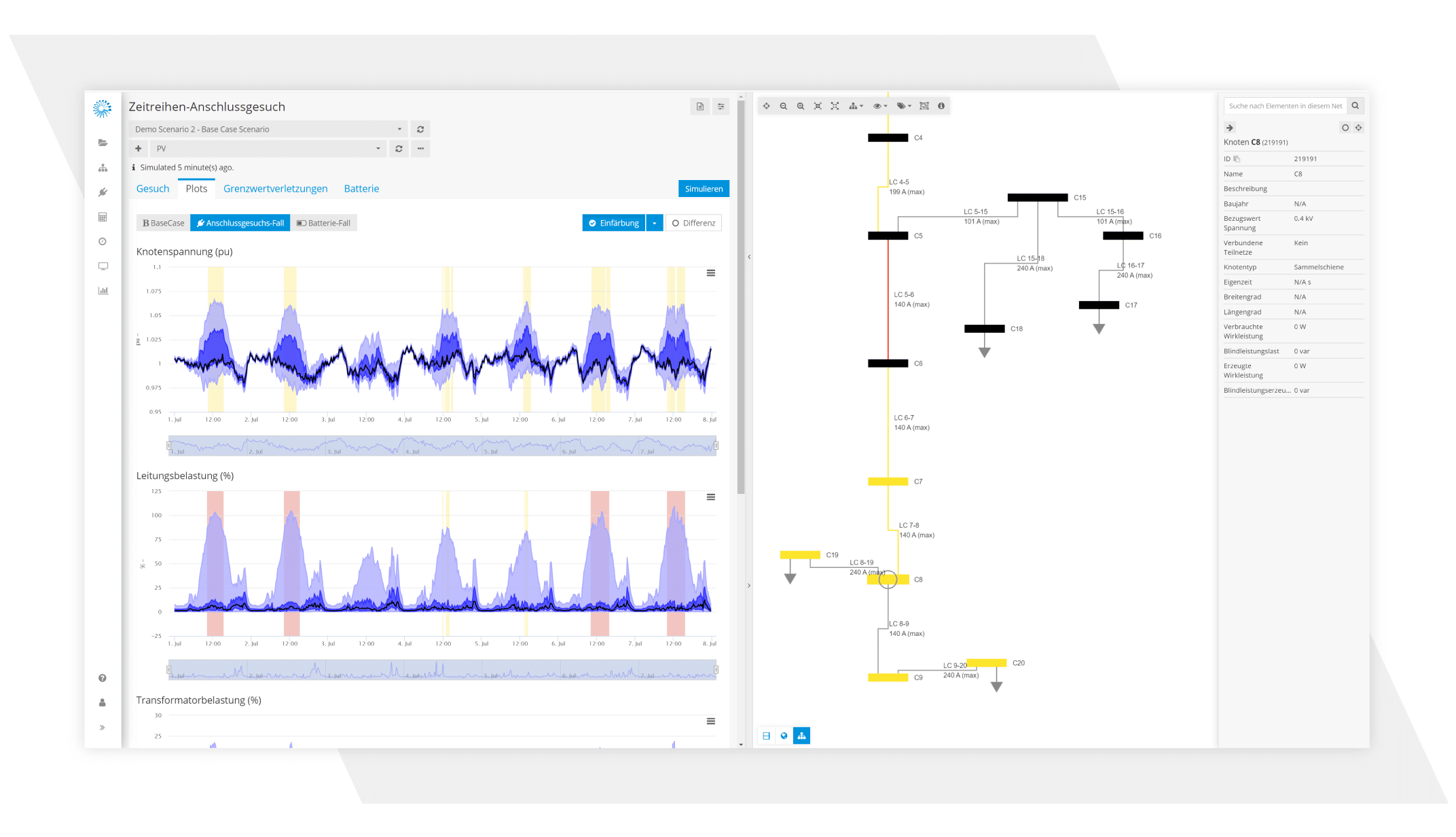
  • Generation of a base-case simulation, representing the status quo of the grid
  • Addition of a new installation with defined time-series
  • Time-series simulation of the grid with and without the new installation, and a comparison of the results and evaluation of the connection request

Advantages

  • Simple evaluation of connection requests based on existing time-series simulations, with intuitive user guidance
  • Simultaneity is taken into account, allowing for less conservative grid assessments, and helping to avoid unnecessary grid upgrades

Battery simulations

Methodology

  • Simulation of a battery storage model as part of the time-series based connection request
  • Assistant makes suggestions for battery sizing and placement
  • Result comparison with and without battery storage unit

Advantages

  • Possibility to plan additional measures for grid integration of new generation plants
  • Low effort for manual configuration, quick testing and iteration of battery placement and dimensioning possible